Formatting A Comma-Delimited Csv To Force Excel To Interpret Value As A
Di: Stella
I use excel to assess exported data. This data is provided to me as a .csv file. In the past I’ve always been fine, just converting the .csv data, delimited by semicolons, to a table range. Here is the problem: since the user name has been added to the csv data, in the format last name, first name ,whenever I now try to open the .csv file the data is now already delimited, however at
How to split delimited data in Excel
The content will show 7 solutions of the issue that Excel not saving CSV with commas. Download our practice workbook and follow us.
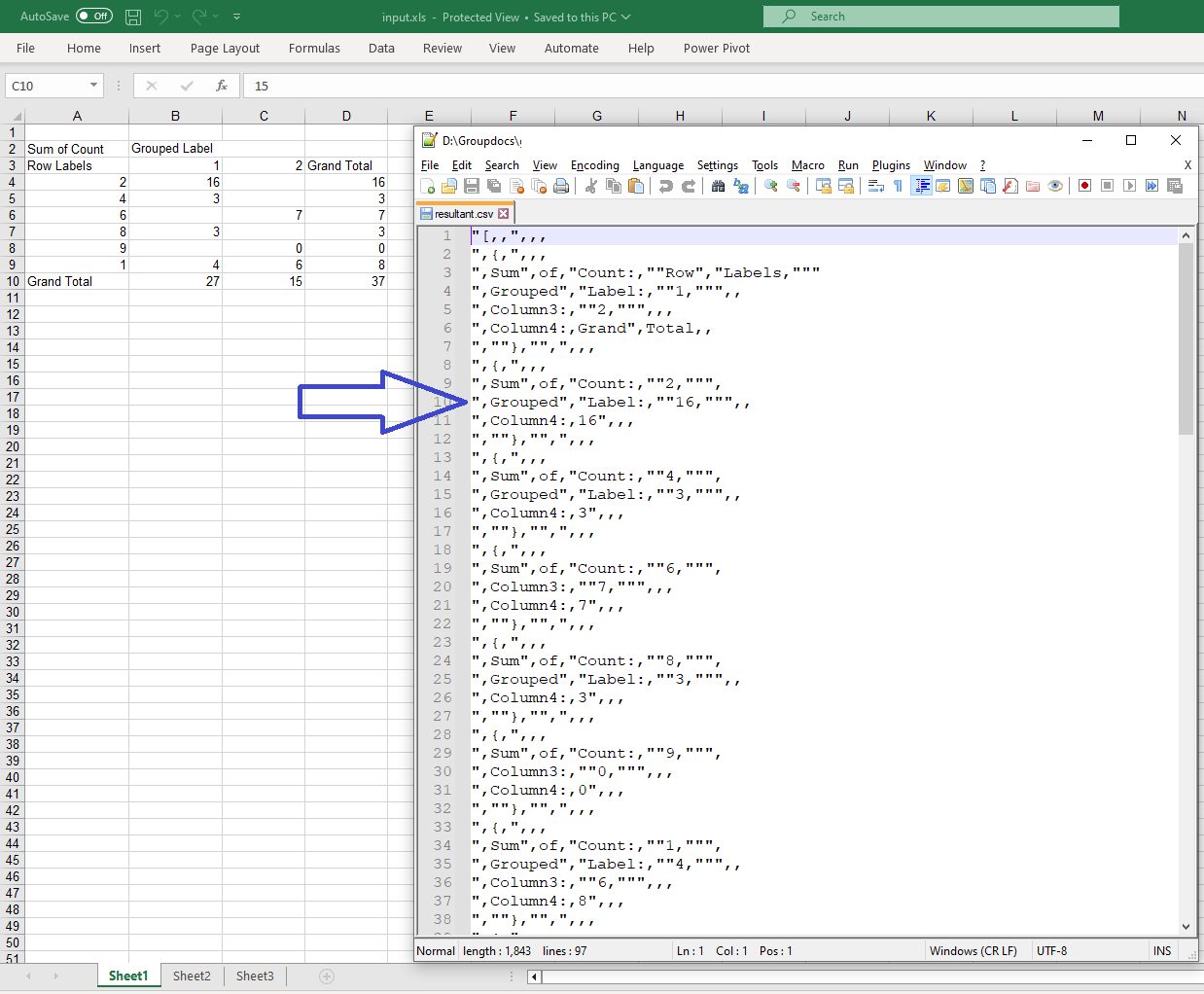
636 Does anyone happen to know if there is a token I can add to my csv for a certain field so Excel doesn’t try to convert it to a date? I’m trying to write a .csv file from my application and one of the values happens to look enough like a date that Excel is automatically converting it from text to a date. There are two ways to import data from a text file with Excel: you can open it in Excel, or you can import it as an external data range. To export data from Excel to a text file, use the Save As command and change the file type from the drop-down menu. There are two commonly used text file formats: Delimited text files (.txt), in which the TAB character (ASCII character code 009) Saving CSV files with double quotes is necessary to avoid any misrepresentation. For example, consider the row of data USD,25,000,Model1. Here, the comma delimiter is a little confusing. Instead, USD,“25,000”,Model1
I have a column in my CSV file that contains a string of numbers separated by commas. Excel keeps converting them to numbers even though I want to treat it as text. Example: 470,1680 get converted to 4,701,680 However, I want it to stay as 470,1680 I tried to format the cells as text but that removes the original comma. How can I achieve this?
Introduction Comma delimited files (CSV) are a common way of storing data in a structured format, with each piece of data separated by a comma. Many systems and applications generate data in this Excel are discussed format, making it essential to know how to work with it. Converting CSV files to Excel format allows for easier manipulation, organization, and analysis of the data. In this tutorial, we
Learn how to easily convert Excel to CSV using Microsoft Excel and Google Sheets. Preserve special characters, fix formatting issues, and avoid data loss. The Problem Microsoft Excel, in its infinite wisdom, chooses to interpret whatever it can as a date when opening a CSV file. For example, I have exported some data from an external application and
Working with data can feel like an endless adventure, especially when you’re handed a comma delimited file, also known as a CSV. These files are like the unsung heroes of data storage, quietly doing their job but often This article shows the 5 effective If working methods to convert an excel file to CSV format. Learn the methods, download the workbook and practice. This article describes three different ways of splitting delimited data in Excel, including Flash Fill, Text to Columns and formulas.
How to Convert Delimited Text Files to Excel Spreadsheets
- How to Convert Excel File to CSV Format
- How to Convert a Comma Delimited File to Excel
- Fix CSV Delimiter Problems: Comma, Semicolon & Tab Issues [2024]
I think the only way to do it is to format the cells as text. Any numerical value will truncate the leading 0’s as excess/ unnecessary information. Do you need the cells stored as values? I am working on Excel in France and the default delimiter is “ [tab]“. I don’t know how to change it in the software but there is a trick: For example, let’s say that your .csv file is delimited with „;“ and you want that Excel interpret it automatically, simply add on the first line of your .csv file the following line: > sep=; When I open the csv file excel formats the field with the long number to a format with exponent syntax: Is there a way to edit something in the query or the sqlcmd job to say excel not to do that?
One way to get total control over how an Excel spreadsheet is imported is to save it as a comma or tab-delimited file (CSV), Then you can use PROC IMPORT with an import type of CSV. This generates DATA step code that you can see in the SAS LOG. Copy this code back into the editor and then you can modifiy the INPUT statement to get all columns imported exactly 17 I think the key issue here is that you are using a CSV, which does not have the cell type embedded in it. Excel ll learn and automatically tries to interpret the cell as having a scientific number which is why you are seeing 5.03E+02 Introduction When it comes to data management, being able to move information from one platform to another is crucial. Excel is a powerful tool used by many for organizing and analyzing data, but sometimes you need to export that data into a different format. This is where creating a comma delimited file, also known as a CSV (Comma-Separated Values) file, comes
I produce a report as an CSV file. When I try to open the file in Excel, it makes an assumption about the data type based on the contents of the cell, and reformats it accordingly. For example, if In Germany, for example, a semicolon is used as a separator between data. In the USA, a comma is used instead. This is problematic, for example, when setting up multiple user accounts in Microsoft 365 using a CSV file. Since Excel was developed in from Excel the United States, you have to use the comma as the separator. Today you’ll learn and practice how to import tab-delimited files into Excel. Picture this: you’ve received a text file packed with crucial sales data, but it’s formatted as tab-delimited data. It feels like trying to open a locked suitcase without the key—you know the information is there, but you’re stuck. If working with files like this in Excel feels intimidating, you’re not
Discussed 5 methods to convert csv into excel with columns. Used Save As, Text to Columns, From Text/CSV, VBA, Legacy Wizard etc.
In this article, 5 distinct problems regarding How to Fix CSV File in Excel are discussed and multiple solutions are given for each problem.
How to Convert CSV to Excel with Columns
Learn how to change the CSV delimiter in Excel sheet for better data formatting and compatibility. Read this article to customize your CSV files easily. Although CSV stands for comma-separated values, it has become a common file type to define simple text files including delimiter-separated data. Thus, a CSV file can use a semicolon or tab character as a delimiter as well. In this guide, we’re going to show you how to change CSV delimiter in Excel. Changing the delimiter in Excel
If you save this file as CSV (comma delimited) and open it in any text editor, all special characters (foreign letters) are displayed as question marks. See below for the CSV file (without UTF-8) opened in Notepad. If you want to Become or hire the top 3% of the developers on Toptal https://topt.al/25cXVn–Music by Eric Matyashttps://www.soundimage.orgTrack title: Switch On Looping–C
We recommend importing the CSV file to an Excel worksheet, instead of simply opening the CSV file, to preserve data integrity. Opening a CSV file using Excel may result in data corruption due to unexpected formatting being added if your settings are not properly configured.
Comma-delimited CSV in Excel separates values in a spreadsheet with commas, while MS-DOS CSV uses tabs instead. The main difference is in how the values are separated and how different programs interpret the data.
Excel only places quotes around certain fields, how do I force excel to save a CSV file with quotes around every column? Discussed 5 methods split comma separated values into rows or columns in excel. Used Text to Columns, Power Query, VBA, Flash Fill etc.. Overview of CSV Comma Delimited Files By default, the delimiter or separator for items in a CSV file can be either semicolon (;) or commas (,). The choice depends on the region where Excel is being used. However, when exporting data from Affinity, commas (,) are used as the default delimiter/separator. This can sometimes lead to difficulties during file uploads or
Though I try to avoid it, I occasionally have to open a CSV file in Excel. When I do, it formats columns containing numbers, which makes them useless for my purposes. As far as I can tell, the data USD only So, for example, if your system generates the CSV file using utf-8 charset, you can add the (Tab Char in Hex) before your numeric value to force excel to interpret it as text.
Excel changes custom format to a date when saving as a csv.
What can this tool do? Use this tool to convert delimited data to another delimited format. You can convert to and from Excel, pipe delimited, colon or semi-colon delimited, comma delimited, tab delimited, or choose a custom delimiter. Common usage is A CSV file refers to the ‘Comma-separated value’ file extension, that allows you to store tabular data for managing data sets or databases. It is a plain text file that can only contain numbers and text values that are separated or delimited by a comma. CSV is a very popular and versatile file format which often used for exchanging data between different I ignore the warning and save anyway but when I close and reopen the file, the cells formatted as text (023), do not save and simply go back to 23. I have tried saving as CSV UFT-8 (Comma delimited) (.csv) as well as Comma Separated Values (.csv) but the problem remains. Any tips on how to solve this?
Excel xlsx keeps converting a custom date, mm-dd-yyyy to the following format mm/dd/yyyy when saving as a csv file. How do I get it to stop, or how can I get this format added to the list of date formats?
- Foodservice Food Waste Action Guide
- Forum: Wirecard – Wirecard Aktie • DE0007472060
- Formas And Polarities : different configurations for different polarities
- Formel 1: Liberty Media Statt Bernie Ecclestone
- Fourball Golf Rules: What About When Your Partner Doesn’T Show?
- Fourteenth Report On Reservations To Treaties
- Former Capitol Hill Police Officer Announces Run For Congress
- Ford Focus Mk 3.5 – Ford Duratec 1.8 HE Engine Specs And Problems
- Fotoshooting Mit Romeo
- Fonts Logo » Whatsapp Logo Font
- Football At The African Games – Football at the 2003 All-Africa Games
- Forbidden Physics _ Architecting Jolt Physics for ‚Horizon Forbidden West‘
- Folia Papierblumen Farbig Online Bestellen