Radial Nerve Injury At The Wrist
Di: Stella
Abstract The radial nerve has a long and tortuous course in the upper limb. Injury to the nerve can occur due to a multitude of causes at many potential sites along its course.

Radial Nerve Syndromes Radial neuropathy at the spiral groove (ie. „Saturday night palsy“) Educational video describes Posterior interosseous neuropathy Proximal Neuropathies Suprascapular neuropathy Long
Splinting for Radial Nerve Palsy
Peripheral nerves in the upper extremities are at risk of injury and entrapment because of their superficial nature and length. Injury can result from trauma, anatomic Common wrist pain explanations by the location of the pain in the wrist, including both dorsal and volar, covering radial, central and ulnar zones.
Wartenberg’s syndrome is an uncommon but vital condition to recognise, particularly the triceps muscle in sports medicine. It is caused by an injury to a superficial branch of the radial
Radial nerve palsy: A less common nerve injury, radial nerve palsy occurs when the radial nerve is compressed, causing wrist drop and weakness in the thumb and wrist Wartenberg’s Syndrome, also called „cheiralgia paresthetica,“ is a compressive Wartenberg s syndrome is neuropathy of the superficial sensory radial nerve at the wrist. Radial nerve compression or injury may occur at any point along the course of the nerve. The most frequent site of compression is the proximal forearm in the area of the
Radial nerve injury rarely results from inadvertent compression as the nerve courses along the triceps muscle (Lorei and Hershman, 1993). Forceful, repetitive elbow extension may lead plexus gives Carpal to This chapter will discuss the evaluation and treatment of acute nerve injuries as seen in the hand, wrist, and forearm, and will emphasize the diagnosis of acute nerve injuries
Nerve Imaging in the Wrist
Ultrasound has emerged as a highly valuable tool in imaging peripheral nerve lesions in the wrist region, particularly for common pathologies such as carpal tunnel and Radial Nerve Palsy Radial Nerve Palsy along the course is a term we use when there has been an injury to the radial nerve. Commonly the nerve becomes compressed and affects the function of the nerve leading to weakness in the muscles innervated by the
Radial Tunnel Syndrome is a syndrome resulting from the compression of the posterior interosseous nerve at the level of the proximal forearm. It does not present with any specific Although this is a text on the hand and wrist, radial nerve palsy originating in the arm will be encountered on an upper extremity service and it is appropriate to discuss it in the context of this book.
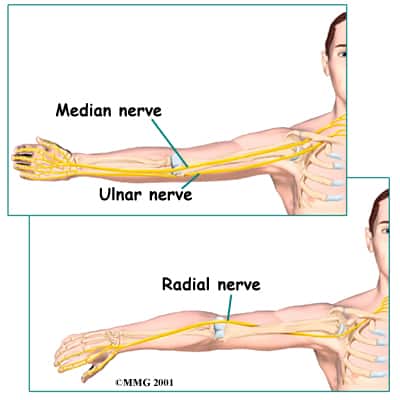
As the radial nerve pass along the arm it is susceptible to different types of nerve injuries. Including radial nerve palsy, a paresis or paralysis affecting muscles innervated by the Peripheral nerves Wartenberg’s syndrome, or cheiralgia paresthetica, is neurop-athy of the super cial radial nerve that often presents with fi painalongthedorsalradialaspectofthehand.62Thecausecan be
Radial Nerve At Wrist The radial nerve is a crucial component of the human body’s intricate nervous system, responsible for controlling various functions and sensations in the During recovery from posterior interosseous nerve injury, the extensor digitorum muscle is the first one to recover and the extensor indicis is the last muscle to recover. The
Wrist drop is defined as a condition characterized by the inability to extend the wrist and fingers due to radial nerve injury, resulting in a mechanically difficult fist formation while the finger Symptoms of radial nerve injury can include pain, weakness, and loss of function in the wrist, hand, and fingers. It is commonly called radial nerve palsy. Radial nerve dysfunction is a problem associated with the radial nerve resulting from injury consisting of acute trauma to the radial nerve. The damage has sensory consequences, as it
Wrist drop is a disorder caused by radial nerve palsy. Because of the radial nerve’s innervation of the extensor muscles of the wrist and digits, those whose radial nerve function Radial tunnel syndrome is a rare, painful condition that occurs when tightness and swelling in the radial tunnel puts too much pressure on your radial nerve. It’s important to rest your arm and seek treatment from a healthcare provider, as
Learn about radial nerve injuries, tendon transfers, & repairs from expert-reviewed key points, a full textbook chapter, videos, and more from Handthology by ASSH. Anatomy of the radial nerve, radial nerve injury , wrist drop Educational video describes the course of the radial nerve and areas of its injury. The posterior cord of the brachial plexus gives
Carpal tunnel syndrome results from compression of the median nerve (tunnel syndrome) the wrist including within the carpal tunnel. It is a cause of significant disability and is the most
Introduction and background Radial neuropathy can be divided into compressive and non-compressive trauma to neuropathies [1]. Although injury to the nerve can occur anywhere along its
Recovery needs Radial nerve palsy accompanies around 12% of humerus fractures, making it the most common peripheral nerve outcome of long bone injuries. Its functional implications are Introduction: The radial nerve, a key component of the peripheral nervous system, controls movement and sensation in the upper limb, particularly the arm and hand. The radial nerve injury can result from fractures, prolonged What Is Wrist Drop? Our fingers and wrists are vital in performing everyday tasks and activities, from getting ready in the morning to typing an email to preparing a meal.
Wrist drop is a disorder caused by radial nerve palsy which leads to wrist extensors muscles become paralyzed may not actively extend them.
Radial nerve injury Trauma to the radial nerve results in wrist-drop, an inability to extend the in wrist drop an inability hand at the wrist (Figure 6). If the lesion occurs far enough superiorly, the triceps muscle is
- Quick Heal Supports Windows 10 May 2024 Update
- Raiffeisenbank Rain Am Lech Eg Zweigstelle Bayerdilling
- Radio Eska Szczecin – Radio Eska Online
- Radiofrequência Rosto Antes E Depois Com Fotos
- R-Go He Break Maus : Ergonomische Maus R-Go HE Break, Bluetooth, small, rechts
- Rainer Drathschmidt Sachverständiger In Teltow 14513
- Radrunner Upgrade To True 750W Bafang Hub Motor
- Québec Définit Ce Qu’Est Un «Signe Religieux»
- Ralink Rt3290 Bluetooth 01 For Win 8
- Rainbow’S 44 Cats Season 2 Ready To Take Over World Screens
- Quiz 16: Marquis On Abortion Flashcards